
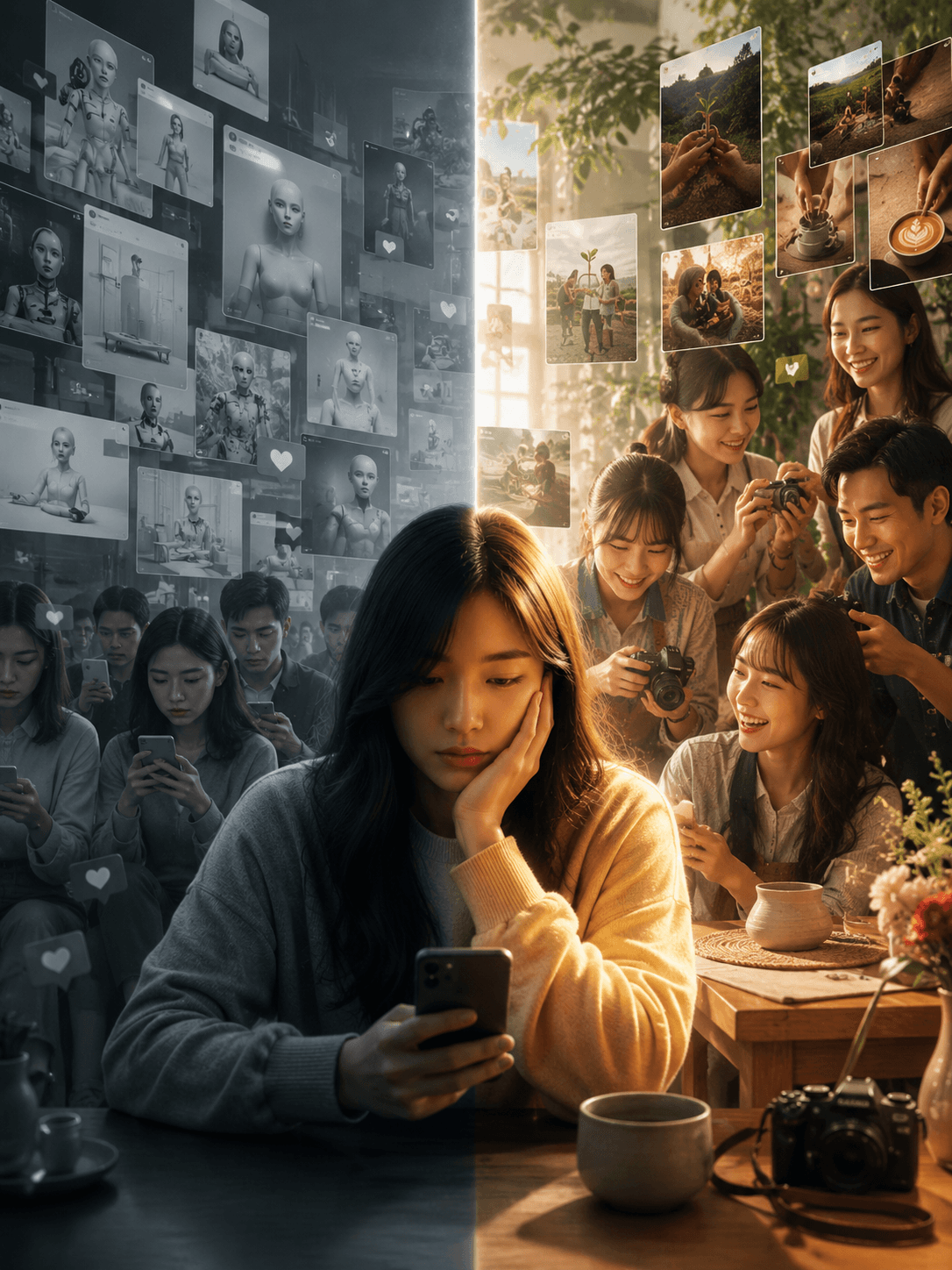
Why People Are Getting Tired of AI Images on Social Media, and What Brands Should Do Next
People are tired of AI images on social media because the brain spots repeated patterns faster than content creators assume. The same family of models, the same set of prompts and the taste the models have been tuned toward mean that millions of images look like they come from the same "family". The more often people see them, the more the viewer's first reaction shifts, within a fraction of a second, from "beautiful" to "fake".
This is not one person's private feeling. An analysis of high-engagement posts across more than 7 online communities by TRG Datacenters in 2026 found that mentions of the term "AI slop" grew more than 9 times in one year, reaching 2.4 million, and 82% of those mentions were negative (Storyboard18, 2026). For SME brands that have just started using AI to make images to save budget, this is the moment to understand the mechanism, not just to produce more, faster.
Why Do AI Images from Different Brands All Look the Same?
Because everyone is walking toward the same "average" of the same models. There are 3 layers stacked on top of each other: most people use a handful of popular models, they use the same set of prompts such as cinematic, 8K, studio lighting, hyper-detailed, and the models are tuned to produce images that people rate as "beautiful", which is a very narrow target. The result is the same kind of beauty across the whole market.
The words we feel make an image look more expensive are the words that pull the model back to the center of the data it was trained on. When a million people use the same words in the same three tools, the results cluster together. Worse, there is a feedback loop: creators see AI images in their feeds, absorb the idea that "good work looks like this", and then write prompts to get the same look again. Viewers' eyes are trained at the same time. The style reinforces itself across the whole system.
What viewers pick up on is no longer the "six fingers" of the early days but finer signals — skin that is too smooth to be real, symmetrical two-direction lighting that is too perfect, background bokeh that is blurred unnaturally evenly, backgrounds with no trace of real use, and a smile angle that is the same in every image.
Why Are People Now So Suspicious That Even Real Photos Get Accused of Being AI?
Because the cost of guessing wrong has been pushed onto the viewer. When there are enough fakes, the cheapest form of self-defense is to doubt everything by default. The side effect is that real photos with nice retouching get accused too, and brands that do not use AI at all lose credibility for free.
A global Baringa survey found that 70% of people are uncomfortable with AI-generated media, and a Publicis media executive said that many young people enter the online world assuming that everything they see is fake (Fortune, 2026). In the Thai context, ETDA is also pushing on this through its AI Governance Center and educational content on AI deepfakes, which stresses that Thai people need the skills to stay alert and not believe only what their eyes see (ETDA).
In business terms: the damage is not only in the images made with AI, but in the fact that all of a brand's images are discredited at the same time. Real photos of the storefront, the real team and the real products have to work harder to prove themselves than they did two years ago.
Does Audience Fatigue with AI Images Really Affect Sales?
Yes, and the numbers are moving faster than many brands think. Fractl tracked the same question for two years in a row and found that the share of people who say they would trust their favorite brand less if it uses AI heavily rose from 20% in 2025 to 40% in 2026 (Fractl via The Slop Tax, 2026).
Gartner shows the same picture from another angle: in 2026, half of American consumers said they would prefer to buy from brands that do not use generative AI in their content, advertising and customer messaging (Klaviyo, 2026), and 49% agreed that overall content quality has gotten worse because of generative AI (Forbes, 2026).
The most dangerous point is the perception gap: 82% of advertising executives believe Gen Z and Millennials feel good about ads made with AI, but in reality only 45% do, and the gap has widened from 32 points in 2024 to 37 points in 2026. This means the people producing content are misreading their audience more and more, not less. An important observation is that younger people are not against AI as a tool. They use it themselves every day. What they push back on is the visible "laziness" in the work that brands release.
If We Keep Using AI for Images, How Do We Avoid Being Seen as Slop?
The answer is not to stop using AI but to stop shipping the model's defaults. The principle is to use AI for work where we already have a direction, not to let AI come up with the direction for us. The images that survive viewers' eyes in 2026 are the ones with traces of a human maker in them, not the ones that are the smoothest.
Practices that work for SMEs:
- Cut the prompt words everyone uses — Stop using cinematic, 8K, hyper-detailed and replace them with details that belong to your own brand, such as material types, real locations, time of day and the lighting your shop actually has.
- Always mix in the real thing — Use real product photos as the main image, and let AI help behind the scenes, such as removing backgrounds, extending frames, arranging composition and making variants for multiple sizes.
- Keep the imperfection — Asymmetrical shadows, real hands in the frame, price tags written by hand. These are evidence that someone was there.
- Be transparent when you use it — Saying plainly that an image is an AI-generated illustration is better than letting people catch it themselves, because being caught does more damage than saying so first.
- Have a person check before every post — The problem with slop is not the tool but skipping the step of human judgment.
From experience teaching the AI Content Creator class for Pisona Group in Phuket (May and June 2026, 40 people per cohort) and the "Claude Design Playbook" workshop at Claude Connect Chiang Mai (July 2026), the point where content teams get stuck most is not writing better prompts, but being willing to throw away an AI image that looks good but is not their own brand. Teams that set review criteria before generating spend less time and end up with more usable work than teams that keep generating and choose afterward.
Frequently Asked Questions
Should we stop using AI for images altogether? Not necessarily. The 2026 data suggests that people push back against work that looks careless, not against the tool. Younger people use AI themselves every day but will criticize brands that use it carelessly. A safer approach is to use AI for behind-the-scenes work and for work that already has a clear direction, while images that are the face of the brand should have real material at their core.
Do we always have to label an image as made with AI? If an image could lead people to believe it shows a real event, a real product or a real person, you should always say so. For graphic illustrations that are obviously not photographs, the need is smaller. The simplest rule for deciding: if someone asked and you would feel like avoiding the answer, that is a sign you should have said so from the start.
Why do customers say our real photos look like AI? It is usually caused by heavy retouching, highly symmetrical studio lighting, backgrounds that are too clean, and the same pose in every shot, which match what people have learned to see as the "look of an AI image". The fix is to retouch skin less, keep the context of the real location in the frame, and leave in details that are not perfect.
Do AI images really reduce sales, or are people just complaining on social media? There are clear behavioral signals. In 2026, Gartner found that half of American consumers want to buy from brands that do not use generative AI in content and advertising, and Fractl found that the share of people who would trust a brand less doubled in one year. This is purchase intent, not just feeling.
Our SME has a small budget and cannot afford real photo shoots. What should we do? Shooting with a phone at your real location still beats an AI image that looks like your competitors'. Invest in natural light and a recognizable, repeated angle, then use AI for back-office work such as removing backgrounds, adjusting proportions for every platform, writing captions or making variants for ad testing.
How should we measure whether our content is being seen as slop? Look at three things: save and share rates relative to reach (people do not save what they think is fake), the share of comments that question whether the image is real, and the CTR of ads using AI images compared with real photos in the same campaign. A two-week side-by-side test will show the difference more clearly than guessing.
Will this trend last, or will people just get used to it? In the short term, sensitivity is still rising, because the volume of AI-produced content is still growing faster than platforms' ability to screen it. In the longer term, what will change is the standard for showing where an image comes from, which Thailand is driving through ETDA's AI Governance guidelines. Brands that start being transparent early will adapt more easily.
Author: Tanyalak Techapeompol Managing Director of Custocare, an AI and Digital Transformation consultancy, with 17 years of IT experience
Profile: tanyalak.net · LinkedIn · Certification
Published: 17/08/2026 | Last updated: 17/08/2026
References
- AI fatigue rises in 2026 as consumer excitement drops to 19% (TRG Datacenters via Storyboard18)
- Businesses are declaring war on AI slop (Fortune, 2026)
- Why Consumers Are Frustrated With AI (Forbes, 2026)
- Consumer Trust in AI 2026 (Klaviyo, citing Gartner)
- Stop the Slop: What the Backlash Against AI Content Means for Your Small Business (citing Fractl 2026)
- Know Your AI Deepfakes (ETDA)