
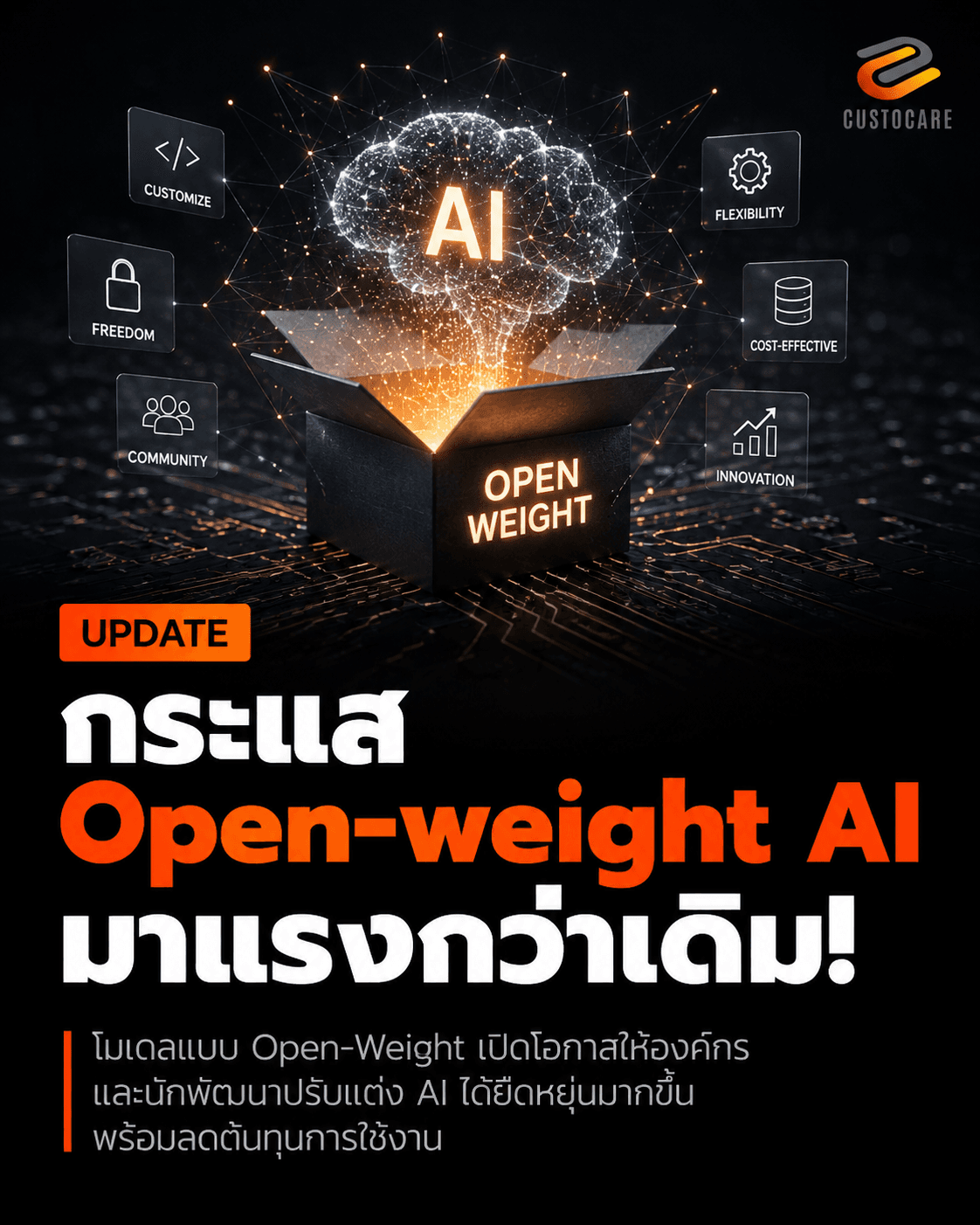
What Is Open-weight AI, and Why Is Every Company Starting to Talk About It?
What Is Open-weight AI, and Why Is Every Company Starting to Talk About It?
If you have been following AI news lately, you may have noticed the term open-weight AI appearing more often. Meta, Microsoft, NVIDIA and AI companies from China are all pushing more models in this form.
Many people assume that open-weight AI is open source AI, but the two are not the same.
This article explains the difference in the simplest terms.
What is open-weight AI?
Open-weight AI is an AI model whose developer lets you download the model weights, the "brain of the AI".
An organization can:
- Download the model
- Install it on its own servers
- Fine-tune it further
- Use it internally without sending data out to an outside provider
In short, you can own an AI that runs inside your own systems.
How does open-weight AI differ from open source?
Many people assume that open-weight AI and open source AI are the same thing, but there are quite a few differences.
🔒 Closed AI
Used through a provider
Suited to general users, or organizations that want to start using AI right away.
Advantages
- Use it through a website or an API
- No servers to install or maintain
- The provider updates the model automatically
- You can start immediately
Limitations
- You cannot download the model
- You cannot fine-tune the model yourself
- You depend on the provider
Examples
- ChatGPT
- Claude
- Gemini
🔓 Open-weight AI
Download the model and run it yourself
Suited to organizations and developers who want more control over how AI is used.
Advantages
- Download the model weights and run them on your own servers
- Fine-tune for specialized tasks
- Keep control of data inside the organization
- Customize usage flexibly
Limitations
- You need a machine or server to run the model
- You need the skills to install and maintain the system
Examples
- Llama
- Qwen
- DeepSeek
🛠️ Open Source AI
Both the model and the source code are open
Suited to researchers and developers who want to study the model or build on it.
Advantages
- You get the model weights
- You get the source code
- You can modify it and build on it
- It is open to research and innovation
Limitations
- Few large AI models open every component
- It takes fairly deep machine learning knowledge
The short version
- 🔒 Closed AI = rent AI through a provider
- 🔓 Open-weight AI = download the model, then run and customize it yourself
- 🛠️ Open Source AI = the model, the code and the components for further development are all open
Why open-weight AI is gaining momentum
1. Lower AI usage costs
Calling AI through an API is billed by the number of tokens used.
The more users you have, the higher the cost.
If an organization can run the model on its own servers, long-term costs may fall and spending becomes easier to control.
2. Data does not have to leave the organization
Many organizations hold sensitive data, such as:
- Banks
- Hospitals
- Government agencies
- Law firms
Running open-weight AI inside the organization means data does not have to be sent to an outside provider, which adds confidence in privacy and data governance.
3. Customizing AI for a specialty
The key advantage of open-weight models is that they can be fine-tuned.
For example:
- A law firm builds an AI that specializes in law
- A hospital builds an AI to assist doctors
- A factory builds an AI to analyze internal documents
This helps the AI understand the organization's context better.
4. Less dependence on a single provider
Many organizations do not want to rely on a single AI provider.
If one day:
- API prices change
- Terms of use change
- The service goes down temporarily
the business could be affected.
Open-weight models are another option that gives organizations more independence.
5. Global competition
Over the past year, open-weight models from many countries, especially China, have developed rapidly.
As a result, competition in AI is no longer measured only by who builds the smartest model, but also by who builds the most open ecosystem with the most users.
Will ChatGPT and Claude disappear?
The answer is probably not.
Closed AI and open-weight AI have different strengths.
Closed AI
- Easy to use
- No servers to maintain
- Models update automatically
- Suited to general users
Open-weight AI
- You control your own data
- Can be fine-tuned
- Can run on the organization's servers
- Suited to organizations and developers
Both approaches are therefore likely to grow side by side.
Summary
If AI competition in 2023–2025 was about
"Who builds the smartest AI?"
then in 2026 the competition is shifting to
"Who lets users own their AI the most?"
Open-weight AI has therefore become a key trend that many organizations are watching, because it adds flexibility, reduces dependence on providers, and gives businesses more room to build AI that fits their own work.