
7 Ways Restaurants Can Use AI, With Copy-and-Paste Prompts for Each
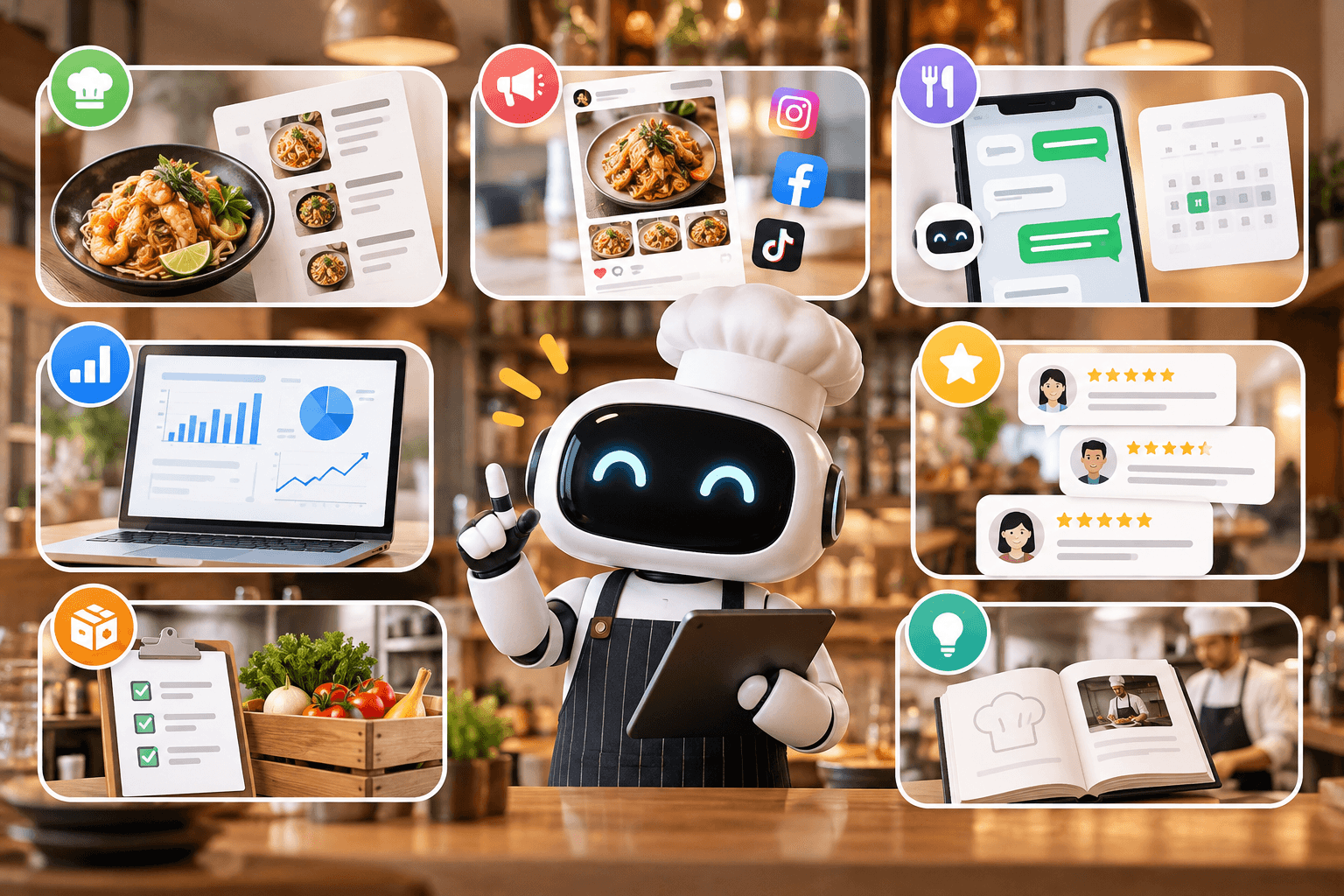
Restaurants can use AI for 7 everyday tasks: photographing menu items, answering order chats, writing promotion captions, cutting unprofitable dishes, calculating ingredient orders in advance, summarizing customer reviews, and building training guides for new staff. Each one can start with data the restaurant already has and a single prompt. You do not need to change your POS system or have an IT team.
The restaurants with the thinnest margins are often not the ones that sell too little. They are the ones carrying small, unnoticed costs. Daily tasks such as photographing menu items, replying to customer chats, or thinking up promotion captions eat up time and money a little at a time until they add up to a large cost. According to McKinsey data cited by TimeForge in 2025, AI-driven workforce management can reduce restaurant operating costs by about 8-12% (TimeForge, 2025). That figure does not include the content and customer-service work where AI can save a great deal of additional time. Every prompt in this article can be copied and pasted into a chat right away. All you need to do is fill in your own restaurant's details in the square brackets.
How much time can AI save on a restaurant's content and promotions?
AI can cut content production from hours to minutes, for both menu photography and caption writing. That lets a restaurant launch new promotions more often without hiring a photographer or an extra admin. It suits restaurants that want to refresh the menu or run new promotions every month, but you need to prepare reference photos and your restaurant's tone of voice first rather than giving vague instructions.
1. Menu photography (AI image generation) — Instead of booking a photographer, setting up lighting, and plating the dish every time you launch a new menu item, AI can create appetizing food images from an ordinary photo. This lets you launch new menu items more often without waiting for a photographer's schedule.
What to prepare: At least one clear photo of the actual dish to use as a reference, or details about the dish (ingredients, plating, colors of the food).
Create an image of [menu item name] in a professional food photography style
Natural side lighting, table-top view (top-down or 45 degrees)
Wood or concrete background, served on [specify type of plate]
Make it look fresh, vibrant, and appetizing
Caution: If you need an image that matches the real dish exactly, AI image generation is still not 100% accurate. It works as a supplementary promotional image, not as the main image that replaces the real thing.
2. Daily promotion captions — Instead of spending 15-20 minutes per post coming up with the wording, AI can draft captions in a few minutes. All that is left is adjusting the tone to match your restaurant's style.
What to prepare: Today's promotion (menu item, discount, conditions) and the tone of voice your restaurant normally uses.
Write a restaurant promotion caption for a [Facebook/IG] post
Today's promotion is [promotion details]
Fun, casual tone with a moderate number of emojis
End with a CTA asking people to message us or visit the restaurant
No longer than 4 lines. Give me 3 versions to choose from
How can AI help manage ingredient costs and the menu?
AI analyzes sales and ingredient data to show which dishes "eat up cost but don't make money" and how much of each ingredient to order in advance. This reduces both end-of-week waste and dishes that tie up stock unnecessarily. Because ingredient cost is usually a large share of a restaurant's revenue, even a small reduction in waste has a clear effect on profit.
3. Find out which dishes to cut — Feed per-dish sales data to AI and it will show the dishes with high ingredient cost but low order volume. These are usually the dishes that simply tie up stock without returning a profit.
What to prepare: A file of per-dish sales for at least the past 1-3 months, and the cost per plate if you have it.
Here are the per-dish sales [attach file / paste table]
Please analyze which dishes sell little but use a lot of ingredient cost
(similar to menu engineering)
Recommend which dishes to cut and which to promote more, with a short reason for each
4. Calculate ingredient needs in advance — AI forecasts the quantities you should order based on past sales patterns. This helps reduce food waste at the end of the week, which is when most restaurants tend to over-order.
What to prepare: Average daily or weekly sales per dish, and your recipes (ingredient quantity per plate).
Based on the average sales [attach data] and these recipes [attach recipes]
Please calculate how much of each ingredient I should order next week
with a 10% buffer to reduce leftover waste
How can AI help with front-of-house and back-office work outside the kitchen?
Answering chats, reading reviews, and training new staff take up far more of an owner's or team lead's time than they realize, because they involve the same questions or the same steps that have to be explained to every new hire. AI can take over this work, leaving your team more time to focus on the customers in the restaurant.
5. Answering order chats — Repeated questions such as "What time do you open? Do you deliver? Is there parking?" can be answered by AI on LINE on your behalf. This reduces the time staff have to step away from front-of-house work to type replies.
What to prepare: Your restaurant's FAQ (opening and closing hours, parking, delivery, payment options) and the menu with prices as a file.
[Set this as the chatbot's system prompt]
You are the admin for [restaurant name]
Answer customer questions in a friendly, polite, and concise tone
Use only this information to answer: [paste FAQ + menu]
If a question is not covered by the information, say that a real admin will get back to them
6. Read 200 reviews in 1 minute — AI summarizes a large number of reviews to show what customers keep complaining about, instead of you reading through them one by one.
What to prepare: Collect reviews from Google or Facebook into a single file (copy-paste or export both work).
Here are 200 customer reviews [attach file]
Please summarize what customers praise most often and complain about most often
Group them into categories (taste / service / cleanliness / price)
and give examples of issues that appear more than 5 times
7. Train new staff — AI helps build guides and quizzes from the work procedures you already have, reducing the burden on the head chef of teaching the same things to every new hire.
What to prepare: The work procedures you actually follow (a rough SOP is fine, it does not need to be exact) and the menu items or recipes staff need to know.
Please create a training guide for new [kitchen / waiter / cashier] staff
Based on these work procedures [attach rough SOP]
Write it as easy-to-understand steps
and add a 5-question multiple-choice quiz at the end of each chapter to check understanding
What data do you need to prepare before these prompts work well?
You need 4 sets of real restaurant data on hand first: a per-dish sales file, customer reviews collected in one place, the menu with prices, and a rough SOP for each position. A prompt without your restaurant's data attached will return generic answers that you cannot use to make decisions.
This is a pattern we see repeatedly in the SME workshops the Custocare team teaches, including the LAMPHUN TECH WEEK 2025 session "SME + Tech: Using Technology to Increase Profit, Cut Costs, and Gain Speed." Most people get stuck because their data is not ready, not because they are bad at writing prompts. Sales data sits in a POS system they do not know how to export from, reviews are scattered across several platforms, or the SOP exists only in the head chef's head. The fastest route is to spend half a day pulling these 4 sets of data into files first, then work through the prompts one at a time.
Frequently Asked Questions
Which task should I start with to see results fastest? Start with identifying dishes to cut and reading customer reviews. Both use data the restaurant already has (sales and reviews), so there is no need to wait for new data to be collected, and you can see results within the first week.
Which AI tools can these prompts be used with? They work with general chat AI tools that accept file attachments, such as Claude or ChatGPT. The exceptions are the menu photography task, which needs an image generation tool, and the chat-answering task, where the prompt has to be set as the system prompt in a chatbot platform connected to LINE OA.
Can a small restaurant use these AI tools, or do you need to be a large restaurant? They work from a single-location restaurant upward, because most of the tools are ready-made apps or chatbots that do not need an IT team to maintain them, unlike the large-scale AI systems that big organizations use.
How much technical knowledge do you need to get started? Most of it runs through chat or apps you already know, such as LINE, so you can start without writing code or having specialist IT knowledge.
How safe is the customer data I give to AI? It depends on the provider you choose. Pick tools with a clear data retention policy, and avoid entering customers' personal data unnecessarily. For example, remove names and phone numbers before attaching a review file.
Does AI really reduce costs, or does it just make work faster? Both. Tasks such as menu photography and captions save time, while tasks such as cutting dishes and calculating ingredient orders directly reduce ingredient costs, which are usually the largest share of a restaurant's costs.
Do I need to replace my entire POS or back-office system? No, you do not need to replace the whole system. Most of the tasks in this article start with add-on tools that work alongside your existing system, such as using LINE OA or the sales files you already have.
Author: Tanyalak Techapeompol Managing Director, Custocare, an AI and Digital Transformation consultancy with 17 years of IT experience Former CIO of Oasis Spa Group, overseeing IT systems across 14 branches in 4 provinces · Speaker at LAMPHUN TECH WEEK 2025 on "SME + Tech: Using Technology to Increase Profit, Cut Costs, and Gain Speed" LinkedIn · Profile
Published: 03/09/2026 | Last updated: 04/09/2026
References